
Contents
If you run a business, you have now been told roughly four hundred times that AI is going to change everything.
You have read the headlines. You have possibly opened ChatGPT, typed something into it, got back a paragraph that was fine, and quietly closed the tab. Somewhere in the back of your mind is a nagging suspicion that other people are getting something out of this that you are not.
Almost nobody has ever actually shown you. That’s the part that goes unsaid. They have told you. There is a difference, and it is the whole difference.
The dance floor taught me this, not the software
I have been teaching for twenty years, and only the subject keeps changing.
It started here in Chilliwack, showing customers how to use a computer when I was a young salesman at Business World. Then English and computers to schoolkids in South Korea. Then salsa in Mexico. Now AI, back where I started.
Twenty years of beginners has taught me one thing that applies to absolutely all of it:
You cannot explain a dance to someone. You have to get them moving in the first ten minutes, and explain what they just did afterwards.
Nobody has ever learned to dance from a description of dancing. They learn by being walked onto a floor by someone who will not let them look stupid, doing one thing badly, doing it again slightly less badly, and discovering about forty minutes in that they are doing it. Only then does the explanation land, because now it is attached to something their body already knows.
AI is taught almost exactly backwards from this. You get the explanation first. Large language models. Prompt engineering. Tokens, context windows, agents. All of it true, none of it attached to anything you have done, so none of it sticks.
What actually stands between you and useful AI
It is not intelligence and it is not technical ability. In my experience it is five specific things, and each one takes about twenty minutes to get past once somebody shows you.
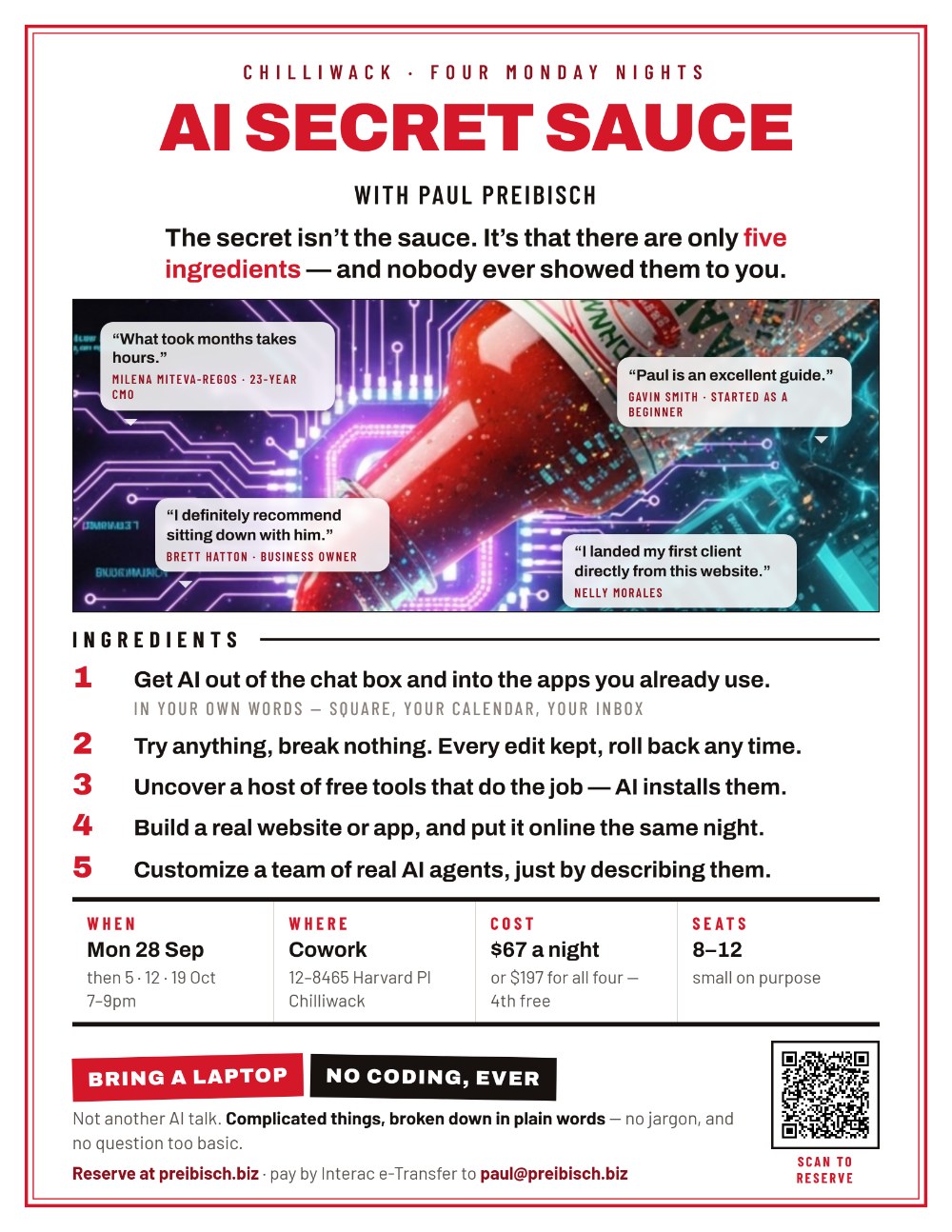
1. AI is stuck in a chat box. You are copying text out of a website and pasting it into your actual work. That is the bottleneck. AI gets useful when it can reach the tools you already use (your files, your site, your calendar, your inbox) instead of you playing courier between two browser tabs.
2. You are afraid of breaking something. Completely reasonable. Most people hold back not because they lack ideas but because it is a live business and they cannot risk it. There is a solved answer to this: a system that keeps every single version of everything, so any change can be undone. You can try anything without being able to break anything.
3. You do not know what tools exist. There is an enormous amount of free, professional-grade software out there, and the reason you are not using it is that nobody told you it existed and installing it looked frightening. AI will find it and install it for you.
4. Putting something on the internet feels like a project. It used to be. Now it takes a couple of minutes, and the first time you watch it happen it is mildly ridiculous.
5. You are doing tasks a machine should be doing. Not big strategic things. The small grinding repeated ones that eat a Tuesday. Those can be handed to AI agents you describe in plain English.
Those five have technical names: connectors and API keys, Git, GitHub, deployment, and agents.
I am telling you the names here because you are reading, and reading is where names belong. In the room, the names arrive around minute forty, as the explanation for something everybody has already watched work. That order is deliberate. It is the same order as the dance floor.
What actually happens on night one
It starts with a piece of paper, not a slide.
Three questions on it. What eats the most hours in your week. How long that job actually takes you. What you would want AI to do about it. You fill it in before I show you anything, because the evening is about your week, not about my software.
There is a fourth column, and it stays empty until the end. How much of that time you get back.
Then we talk, and then I show you what I actually run:
- The dashboard I keep for every project, so I can see where each one stands without going looking.
- The automation that handles my marketing.
- The one that runs ticketing for my dance nights.
- The one that goes out and finds clients.
Real systems, live, working. Not screenshots and not a slide deck about what AI could theoretically do.
The part that is actually the secret
Here is what you notice once you have watched four of these in a row: they are all the same thing underneath.
Not one of them is really about prompting. None of them is about picking the right chatbot. Every single one comes down to one problem, and it is the problem nobody teaches:
How do you connect AI safely to the services you already pay for?
That is it. That is the secret sauce. It is the difference between AI as a party trick you show people, and AI as something that quietly does a job for you every week without you worrying about what it might touch.
Once you can see that pattern, every tool you meet afterwards stops being mysterious. You stop asking “what can this AI do” and start asking “what can I safely connect it to.”
What you do not need
A laptop. Any technical background. To keep up with anything.
Nobody is going to be sat in front of a screen typing while I talk. This is a working session, not a bootcamp: you have a sheet, you have questions, and you have four real systems taken apart in front of you until the shape of them is obvious.
I am also not going to pretend it is hard. It is not hard. That is precisely the point, and there is no way to make you believe it except to do it in front of you.
It is also not a trick. The site for my own dance business, bclatindance.com (the pages, the posters, the ticketing) runs on exactly what I will be showing you. When somebody asks whether any of this actually works, that is the thing I point at.
Here’s a 30-second look at what the course is:
The details
AI Secret Sauce runs four Monday evenings: September 28, then October 5, 12 and 19, 7 to 9pm at Cowork Chilliwack, 12-8465 Harvard Place.
$67 a night, or $197 for all four. The fourth night is effectively free if you take the pass.
No coding experience needed and nothing to bring. You leave with the sheet you filled in, a number in the last column, and the pattern that makes the rest of it make sense.
The room is deliberately small. That is not a scarcity tactic. It’s that this only works if I can get to everyone, and beyond about a dozen people I cannot. Two seats covers my costs for the night, so I would rather run it small and properly than fill it and teach at people.
Details and registration are here. Payment is Interac e-Transfer to paul@preibisch.biz, and seats are held in the order transfers arrive.
If you are on the fence
Come to night one. Pay for the single evening, watch what happens, and decide afterwards whether the other three are worth it. I do not offer the four-night pass until the end of the first session, and that is on purpose: you should not have to trust me in advance about something I can just show you.
Which, in the end, is the entire argument. Everybody in Chilliwack has been told about AI.
This is the one where somebody shows you.
Journalists and event organisers: photos, a print-ready poster and a short bio are all on the media page.
Comments
Loading comments…
Leave a comment