
Contents
Over the last year, a lot of people have been trying to work out the same thing: how do you get an AI to be useful every day, not just impressive in a demo? Two open-source projects have become the loudest answers.
OpenClaw came first. Peter Steinberger, an Austrian developer, put it out in November 2025 under an earlier name (it went through Clawdbot and Moltbot before landing on OpenClaw at the end of January 2026). It runs on your own machine, remembers things, and talks to you through the apps you already use, like WhatsApp, Telegram, Discord and Slack. Hermes Agent followed from Nous Research, with its first public release in March 2026. Same general idea: a persistent agent with memory that can pick up skills and go do things for you.
Both are impressive. Both have also been hard for regular people to use. You’re installing from a terminal, wiring up model providers and API keys, deciding on sandboxes, and keeping it all running. That’s a lot of setup before it does anything useful, and most people give up before they get there.
The trend: a team instead of one super-bot
What I find more interesting than either project is what they point at. The first instinct was one bot that does everything. That’s turning out to be the wrong shape. The direction things are moving is a team of specialized bots, one per task. A copywriter bot that only writes copy. A research bot that only researches. Something in the middle that decides who gets what.
I already knew this pattern from programming. I’ve used the BMAD method for months, where instead of asking one assistant to be everything, you talk to a product manager, an architect, an analyst, a developer, each with its own job and its own way of thinking. It works better than a generalist, and it’s easier to reason about, because when something goes wrong you know which one to blame.
The missing piece was a good way to manage a team like that if you’re not a programmer.
Grok Bot, and the day it ran out
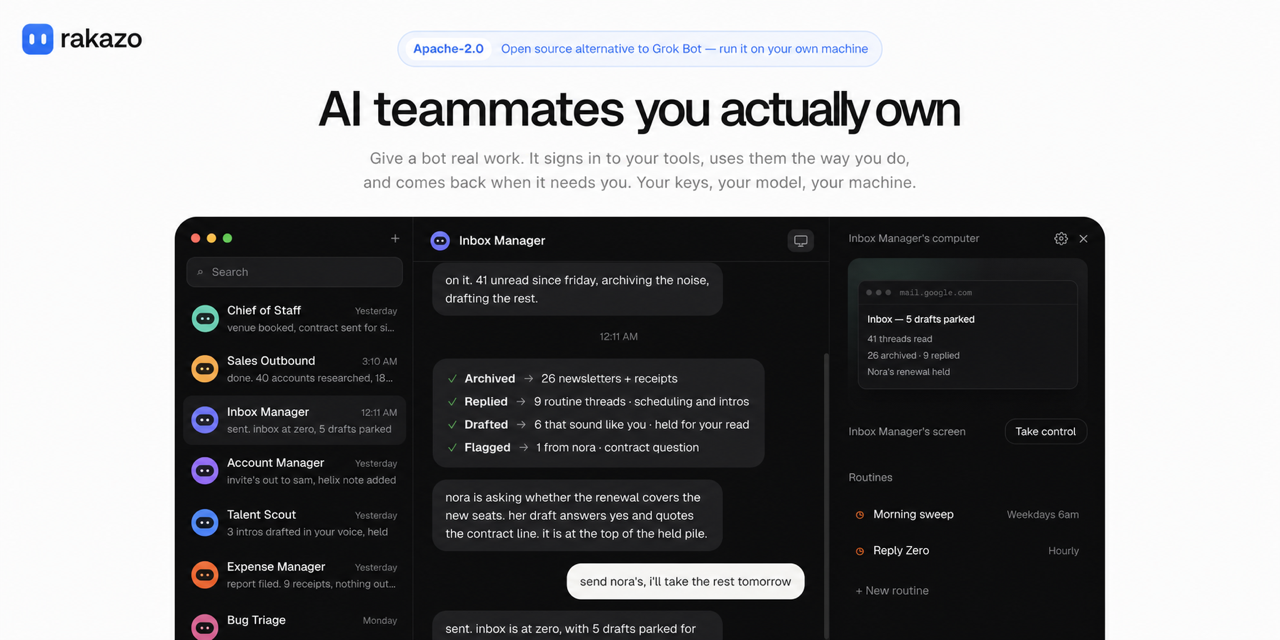
In August, xAI announced Grok Bot, and it was the first time I’d seen that team idea wrapped in an interface that made sense. Each bot gets its own cloud computer, its own browser, its own files. You make a bot, give it a job, and it works through it and comes back when it needs approval. It looked like BMAD for everyone else.
So I tried it. I paid $30, set up a few bots, and ran out of credits in about a day. Not a week. A day.
I’m not going to pretend that’s a scandal. Bots that drive browsers and read long histories eat tokens, and the pricing on these plans has been shifting around. But it meant I couldn’t really find out whether the team approach worked for me, because I was paying by the hour to discover it.
Looking for an open-source alternative
So I went searching for something open source that gave me the same kind of interface, where I could run my own team and control what it costs. That’s how I found Rakazo.
Rakazo is a self-hosted AI teammate platform. You run it on your own server, and each bot is a continuing identity with its own instructions, its own memory and its own conversation, not a prompt you re-explain every morning. It has the thing OpenClaw and Hermes are missing for most people: a plain interface for creating and managing a roster, where you read what each bot said and stop one when it’s gone off the rails.
I have 19 bots on it now.
Because I’m a software developer, I didn’t just use it. Rakazo is open source, so I’ve contributed to it, and one of the things I built is an artifacts feature. If a bot has something to show you, like a report, a draft layout or a dashboard, it can publish an artifact and you see it right inside the Rakazo interface, without digging through a wall of chat text. It works a lot like artifacts in Claude Code, where the agent turns its work into a live page you can open and read.
What the team looks like
Here’s a sample of who’s on it:
 Chief takes whatever I throw at it, decides which bot should handle it, and comes back with one answer so I don't have to remember who does what.
 Bianca runs the Facebook Page and Instagram for BC Latin Dance, drafts ads, and preps every Tuesday and Friday salsa night: head count, who's paid, who owes, the door sheet.
 Marguerite Social plans the content calendar for Marguerite Vallée, the AI influencer we're running as a live experiment.
 AI Secret Sauce owns the course: the teaching material, the seat count, every confirmed fact, plus its own Facebook Page and Instagram.
 Human Copywriter rewrites drafts so they don't sound like a machine wrote them. It drafts, that's all. It publishes nothing.
 SEO Scout finds keyword gaps for this site and hands back briefs, without touching a live page.
 Relationship Bot notices who I'm overdue to message and drafts something in my voice. It never sends.
 Sunny logs into Suno in her own browser and makes original music for the influencer videos.
 Job Finder handles a personal errand: it hunts remote AI-training work.
 Car Finder handles the other one: it's quietly shopping for a Baja-capable vehicle.
There’s also a cluster running the BMAD personas (Mary the analyst, John the product manager and a few more) as standing bots instead of one-off sessions.
None of them can do each other’s jobs, and that’s fine. A generalist has to hold all of it in one head. Specialists don’t.
Every bot has guardrails
A team only works if the members stay in their lanes, so almost every bot brief I’ve written says so in plain language: draft only, never post, never spend, never send without a yes, invent nothing. Bianca drafts ads and I place them. Sunny generates music, but I type the Suno login myself and she never sees the password.
It ends up feeling less like a room of interns and more like a team with actual job descriptions.
When it broke
It wasn’t clean the first time. On September 24, one browser-driving run from the AI Secret Sauce bot made 275 tool calls and burned through 26 million input tokens in one stretch, enough to rate-limit the whole account. Which, yes, is the same kind of problem that ate my Grok credits, just on my own hardware where I could actually go fix it.
The fix was structural. A hard fuse now ends any turn at 120 tool calls. A watchdog asks the bot for a checkpoint at 60 so a long run can wrap up cleanly. Every bot’s instructions carry the same rule about not chaining big batches in a single turn. A separate fix the next day stopped the platform re-writing the same old browser state into the cache over and over, which turned out to be most of the cost.
That’s the part nobody puts in the demo. Running an AI team means building the guardrails after the first time something runs longer than you meant it to.
This is part of AI Secret Sauce
Building a scoped, individual bot for a real job, and giving it guardrails instead of free rein, is one of the five things we show live in the AI Secret Sauce class at Cowork Chilliwack. Watch it done, at normal speed, nothing hidden.
See the course →Where I’ve landed
I don’t think OpenClaw and Hermes are the wrong bet. They’re early, and they’re showing everyone what’s possible. But most people won’t get past the install, and a team of bots needs a way to see and manage the team, not just a way to run it.
For me, that’s Rakazo right now. I’ll keep adding bots as new jobs show up, and I’ll keep writing down what breaks.
Want me to set it up for you?
I can set Rakazo up for you. That means I help you stand up your own server and lock it down properly. I add a secrets manager, the same enterprise-grade kind of vault companies use, so your API keys never sit in a text file. I put Tailscale on it so your own devices can reach it from anywhere and nobody else can. Then you have your own team of AI agents, running on your own hardware, the way mine does. You’d need three things on your side: a Tailscale subscription, a server from Hetzner, and a Claude Code subscription at the Pro level or higher. I’ll walk you through signing up for each.
If that sounds useful, get in touch.
Keep reading
- We Tried Building an AI Team on Grok. Here’s Why We Moved to Self-Hosted Rakazo Instead: the migration story, including wiring a bot into real WhatsApp lines via MCP
- Meet Marguerite: We Built an AI Influencer to See If She Can Hit 21,000 Followers by Halloween: the experiment Marguerite Social runs content for
- Why I Love the BMad Method: Multi-Agent AI Development Done Right: the framework behind the BMAD personas now running as standing bots
- Shipping Fast With AI? Here’s the Server Security Stack You’re Probably Skipping: how the tokens running this whole roster stay out of plaintext
Comments
Loading comments…
Leave a comment