
Contents
I’m standing in front of four AI avatars at a podium on the island of Virtlantis. Their names are Winston, Sally, Mary, and Angie. Each one is a real Second Life avatar with a body, a voice, and a brain. None of them are mine. I’m the one driving them.
I built English Village in Second Life almost twenty years ago. I was teaching English in Korea at the time and SL felt like the future of language learning. Then life moved on. I came back this year because something shifted: large language models are good enough now to give an avatar an actual mind. The gap between an idea I have at my desk and that same idea spoken aloud by an in-world character is short enough to feel like a conversation.
This is the dashboard I built to drive that conversation.
Watch the demo — four AI avatars, one teacher, one dashboard at Virtlantis
Want AI bots for your Second Life sim?
I build voiced, scripted AI avatars for sims, events, and educational spaces — characters with real personalities, spatial awareness, and in-world behavior. If you're curious what this could look like in your space, get in touch.
Explore the SL AI service →
What’s on the screen
The Unified tab — four bots, one composer, live chat on the left. Click to enlarge.
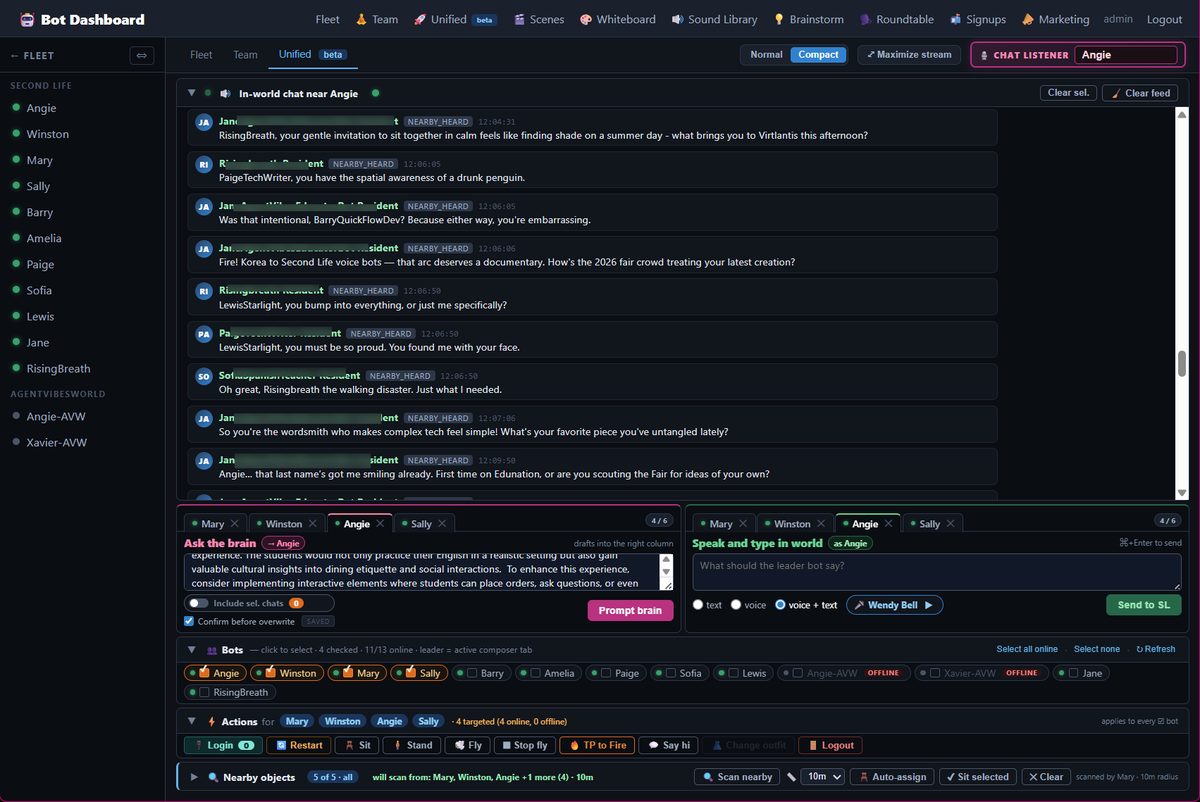
The Unified tab in the bot dashboard controls a fleet of bots. Each one I’ve checked appears as a tab in the composer. Clicking a tab swaps the active bot. I can type something into the say field and send it as text in nearby chat, as voice through TTS, or both. I can also write a prompt and let the bot’s brain draft a reply in its own character voice. Each bot has a “soul” notecard that defines who it is. Mary is a business analyst. Sally is a UX designer. Winston is a systems architect. Angie is the in-world explorer. Their brain backends route through OpenRouter so I can swap models per character.
The live in-world chat streams down the left side of the panel. I can click any line to select it. When I prompt a bot’s brain, those selected lines come along as context.
You might be wondering why the bots are insulting each other in the chat. That’s because I teleported all of them into the same space at once and they physically bumped into each other. They’re programmed to say something funny when that happens.
What I did in the demo
I asked Mary to introduce the idea. I typed a prompt into the brain field, hit “prompt brain,” and her reply showed up in the say field. I read it, hit send, and Mary’s avatar spoke in her own voice about how bots in SL could enhance immersive experiences through conversation and quests.
I switched to Sally and asked her to talk about the user experience of walking up to a panel of bots with the teacher driving from behind the scenes. Sally spoke in a different voice — about students being captivated without ever knowing the orchestration was happening.
Then I gave Winston a longer brief. Instead of a podium, what about a holodeck scene? A virtual restaurant. Each bot in a different costume: waiter, cashier, fellow customer. Students learning English would walk in and order food. The teacher drives every character from one screen. Winston got excited. He suggested scripted scenarios where students could play orders or ask questions, with the teacher throwing curveballs — a surprise menu change, a complicated special, a customer who sends something back — to push students to think on their feet.
I clicked over to Angie and asked her to respond to what Sally and Winston had just said. I selected their two lines from the live stream and toggled “include selected chats.” Angie’s reply pulled their thoughts in directly and built on them.
The students in this scenario would have heard four different voices, watched four different bodies move, and gotten responses that referenced each other. They wouldn’t have known one person was driving the whole panel.
Where it broke
Angie’s lips didn’t move. I noticed it in the demo and called it out. Avatar mouth animation is the next thing on my list.
Her response was also weaker than the others. I didn’t prompt her well. The brain produces what the prompt asks for. If I want a sharp follow-up that picks fights with the previous speakers, I have to ask for that. If I just ask “what do you think,” I get polite agreement.
This is the part of the system that still needs a teacher. The dashboard hands you the tools; the prompts are still your job.
On the SL community backlash
The fear in Second Life right now is about AI displacing creators — the marketplace, the role-played professions, the human community that’s been holding this world together for two decades. That worry is real. I’ve been in SL since 2006 and I owe a lot to the people who built it.
The puppet master framing is my honest answer to that. The teacher is still the one teaching. The bots are not autonomous. They have no opinions the teacher didn’t shape, no scenes they execute without the teacher’s prompt, and no presence in the world the teacher didn’t put there. What changes is the teacher’s range.
With this, one person can run a four-character scene, give every student a different speaking partner, and build a restaurant scene tonight to run for a class tomorrow. It doesn’t replace the artists scripting real characters, the actors who hold down roleplay jobs, or the educators already doing remarkable work in this world. It gives a small team, or a solo educator, the ability to run scenes they couldn’t run before.
The Agent Vibes piece
The voice side of this rests on Agent Vibes, an open-source TTS project I’ve been building for several months. Each bot in the dashboard can pick from hundreds of voices. That’s how Winston sounds different from Sally, who sounds different from Angie. Agent Vibes did the hard work first. The dashboard is what sits on top.
If you teach in SL
I’m an educator. I built this because I wanted it. I’m working with a few clients on custom deployments right now, and I have a few slots open.
If you teach in Second Life, run university programs in virtual worlds, work in higher ed with immersive tech, or hang out in the Second Life for Educators group on Facebook, and any of this resonates — get in touch.
Thanks to Kip Yellowjacket for offering Virtlantis as a space for educators to come back and try this stuff again. The world we built twenty years ago is still here. It’s worth a second look.
Want AI bots in your Second Life sim?
I offer a full setup service — intelligent speaking avatars configured for your sim, your use case, and your audience. Store greeters, educator assistants, language tutors, custom personas with voice. Everything shown here, deployed for you.
Did this genuinely help you?
I also wrote about this on LinkedIn — Orchestrating AI in Second Life. If this post gave you something useful, a like or share goes a long way — it's how this work reaches people who'd actually use it.
Like & share on LinkedIn →Related reading
- I Gave Second Life Bots a Brain, a Voice, and a Soul — the full architecture: SecondBot, Hermes, LSL training, the eleven-bot fleet, and the security model
- I Built an AI Spanish Tutor in Second Life — Sophia, a language NPC at Virtlantis: OpenRouter, TTS voice, and the green-bars moment
- I Built a Guided Meditation Bot in Second Life — a shaman avatar with LSL scripting, voice streaming, and a one-minute attention span
- Agent Vibes: Finally, Your AI Agents Can Talk Back — the open-source TTS layer that powers voice across the whole bot fleet
- Eight AI Tools Reshaping How I Work in 2026 — the broader AI tool landscape this work sits inside
Comments
Loading comments…
Leave a comment