
Contents
For a while we ran this the way most people do: one AI assistant, asked to be everything. Marketing copy one minute, event logistics the next, then customer research, then a half-remembered task from three days ago it had already lost. That’s not a bot with a job. That’s a chatbot with a to-do list too long to hold.
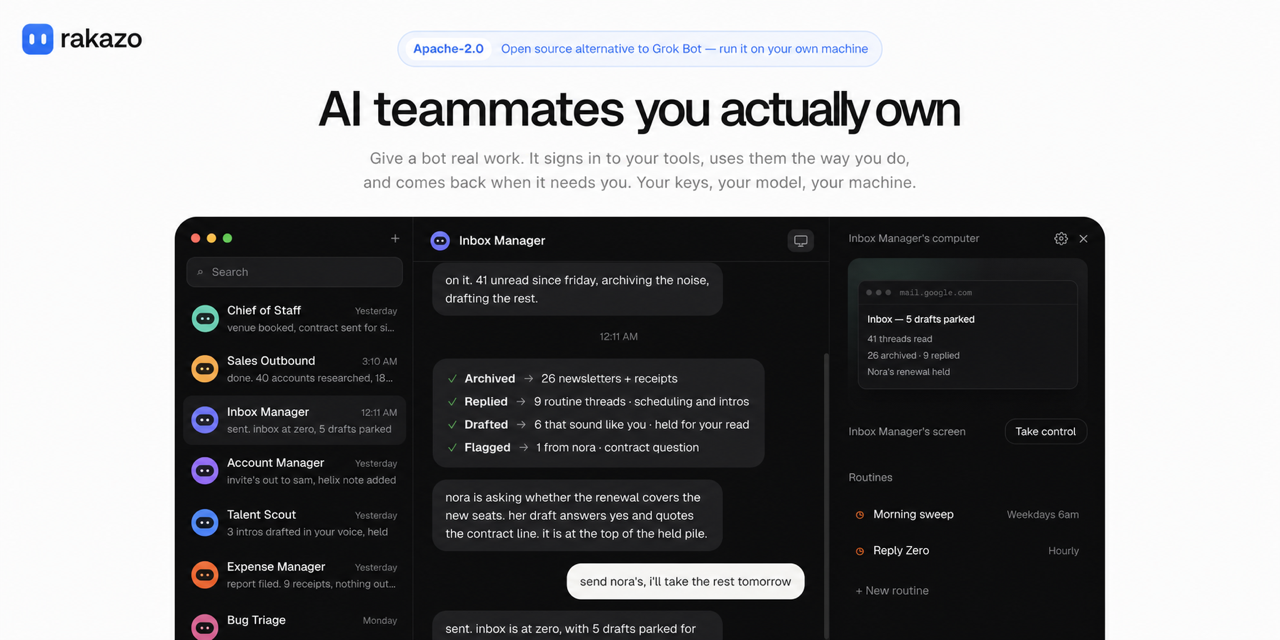
So we split it up. Every real, recurring job now has its own bot: its own memory, its own instructions, its own narrow lane. Right now that’s nineteen of them, running on Rakazo, the self-hosted, open-source AI teammate platform we moved our whole roster onto after running out of context on Grok’s bot tools in about a day and a half.
Nineteen bots, nineteen jobs
Here’s a sample of what’s actually running:
- Chief routes everything else. An unshaped request comes in, Chief decides which bot should handle it, gets it done through them, and reports back one clear answer instead of making Paul figure out who does what.
- Bianca owns BC Latin Dance’s Facebook Page and Instagram, drafts and places ads, and preps every Tuesday and Friday salsa night: head count, who’s paid, who’s owing, the door sheet.
- Marguerite Social plans and drafts the content calendar for Marguerite Vallée, the AI-generated influencer we’re running as a live experiment, across TikTok, YouTube, and Instagram.
- AI Secret Sauce owns the course end to end: the teaching material, the seat count, every confirmed fact about it, and posts directly to its own Facebook Page and Instagram.
- Human Copywriter does one thing only: rewrites drafts so they don’t read like a machine wrote them. Draft-only. It invents nothing and publishes nothing.
- SEO Scout researches keywords and content gaps for this site and hands back briefs. It never touches the live pages itself.
- Relationship Bot keeps track of the people in Paul’s life who are overdue a message, and drafts one in his voice. Private, and it never sends anything on its own.
- Sunny logs into a Suno account in her own browser and generates original music for the influencer videos, then saves the files.
- Job Finder and Car Finder run on the same pattern but for entirely personal errands: one sources remote AI-training roles, the other is quietly shopping for a Baja-capable vehicle under a specific set of legal and drivetrain rules.
There’s also a small cluster running the BMAD method personas (Mary the analyst, John the product manager, and a few others) as standing bots instead of one-off agent sessions. Same platform, same idea, a different kind of job.
None of these bots know how to do each other’s work, and that’s the point. A generalist assistant has to hold all of this in one head at once. Specialists don’t.
Every bot is on a leash
Splitting the work into separate bots would be pointless if each one still had free rein. It’s the opposite here. Almost every bot brief we’ve written carries an explicit boundary in plain language: draft-only, never sends without approval, never posts, never spends, invents nothing.
Bianca drafts ads; she doesn’t place them without a yes. Relationship Bot writes the message; it doesn’t send it. Human Copywriter rewrites the sentence; it doesn’t publish the page. Sunny can generate music in a browser session, but Paul types the login himself during a handoff, and she never sees or stores the credentials.
The result reads less like a team of interns and more like a team with real job descriptions, each one scoped down to exactly what it’s trusted to do alone.
When it broke
None of this was designed perfectly the first time. On September 24, one browser-driving run from the AI Secret Sauce bot made 275 tool calls and burned through 26 million input tokens in a single stretch, which was enough to rate-limit the whole account for a while.
The fix wasn’t “use a smaller model” or “trust it less.” It was structural: a hard fuse now ends any turn at 120 tool calls, a watchdog sends a checkpoint request at 60 so a long run gets a chance to wrap up cleanly before it’s cut off, and every bot’s instructions now carry the same shared rules about not chaining big batches of work in one turn. A separate fix, deployed the next day, cut down how much of that run was being spent re-writing the same old browser state into the cache over and over, which was most of where the cost was actually going.
It’s a small, unglamorous story, but it’s the real one: the interesting part of running an AI team isn’t the demo. It’s what you build after the first time something runs longer than you meant it to.
This is part of AI Secret Sauce
Building a scoped, individual bot for a real job, and giving it a leash instead of free rein, is one of the five things we show live in the AI Secret Sauce class at Cowork Chilliwack. Watch it done, at normal speed, nothing hidden.
See the course →Why this over one assistant
Rakazo’s own project notes put it plainly: a bot is meant to be “a continuing identity with one visible conversation and durable working state,” not a prompt preset you re-explain your situation to every time. That’s the difference in practice. Chief doesn’t need to be told who Bianca is or what a salsa night looks like. Bianca doesn’t need to know anything about Marguerite’s sixteen Halloween costumes. Each one just needs to be good at its one job and know where its boundary is.
We’ll keep adding bots as new jobs show up, and keep writing down what breaks when one runs longer or does more than we expected. That part isn’t finished. It’s the actual work.
Keep reading
- We Tried Building an AI Team on Grok. Here’s Why We Moved to Self-Hosted Rakazo Instead: the migration story behind this roster, including wiring a bot into real WhatsApp lines via MCP
- Meet Marguerite: We Built an AI Influencer to See If She Can Hit 21,000 Followers by Halloween: the experiment Marguerite Social is running content for
- Why I Love the BMad Method: Multi-Agent AI Development Done Right: the framework behind the BMAD personas now running as standing Rakazo bots
- Shipping Fast With AI? Here’s the Server Security Stack You’re Probably Skipping: how the tokens running this whole roster stay out of plaintext
Comments
Loading comments…
Leave a comment